Table of Contents
- Paintless Dent Repair vs Body Shop: The Core Difference
- Cost Comparison: PDR Cost vs Body Shop Pricing
- How Long Does Paintless Dent Repair Take?
- Does PDR Affect Factory Paint and Warranty Retention?
- When to Choose Paintless Dent Repair
- When Traditional Body Work Is Necessary
- Lease Returns, Resale Value, and Insurance Claims
- Frequently Asked Questions
Last Updated: September 26, 2026
Paintless Dent Repair vs Body Shop: The Core Difference
The core difference between paintless dent repair and a traditional body shop comes down to how each method restores your vehicle. Paintless dent repair, or PDR, reshapes the metal from behind the panel while keeping your factory paint untouched. A traditional body shop sands, fills, and repaints the damaged area.
At Hail Dawgz, we have spent more than 20 years working both sides of this equation, and the choice matters more than most drivers realize.
PDR is the process of massaging a dent out of a vehicle’s body panel using specialized rods and tools, without sanding, body filler, or repainting. The National Automobile Dealers Association guide to vehicle value notes that original factory finish protects resale value in ways a repaint rarely matches.
How Paintless Dent Repair Works
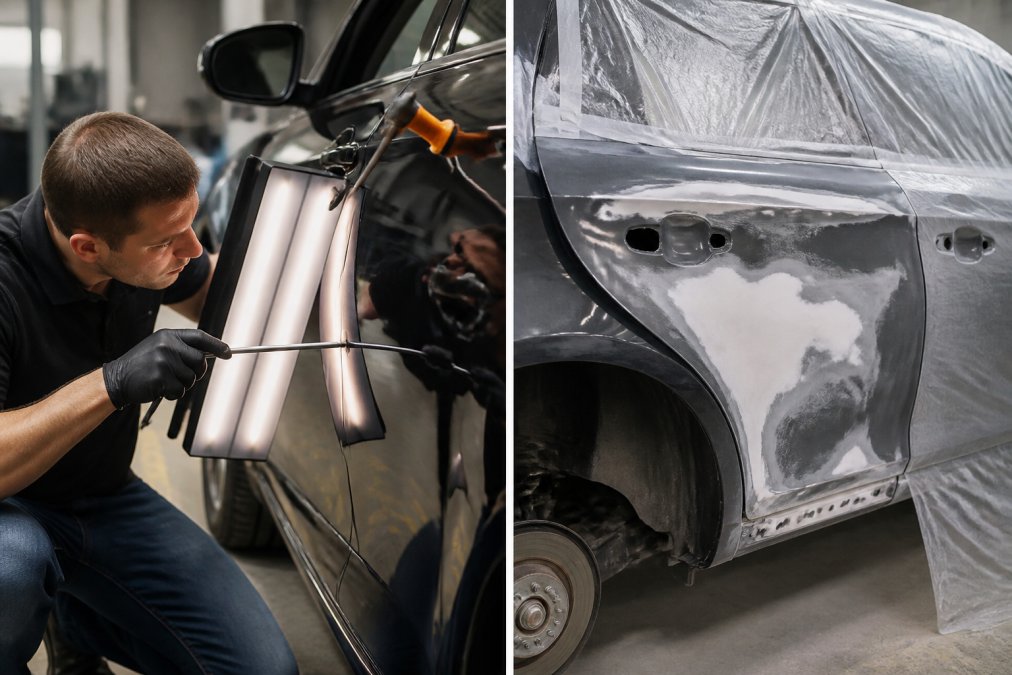
A PDR specialist locates the back of the dented panel, then applies gradual pressure at precise use points until the metal returns to its original shape. The technique relies on metal memory, the tendency of sheet metal to spring back once the right force is applied. No sanding, no primer, no curing time.
How Traditional Body Shop Repair Works
Traditional repair is a multi-stage process. A technician sands the damaged area down, pulls or hammers the metal, applies body filler (often called Bondo), sands again, sprays primer, then paints and clear coats. Each coat needs curing time before the next step. The result can look flawless, but the panel no longer carries its factory finish.
Cost Comparison: PDR Cost vs Body Shop Pricing
PDR cost vs body shop pricing usually favors PDR, but the gap depends on the damage itself. PDR avoids paint materials, labor hours, and curing time, which is where much of a body shop bill comes from. Pricing for any specific repair depends on dent count, size, depth, and panel access, so ask for a written estimate rather than relying on general figures.
The real cost driver is not the dent, it is whether the paint and metal survived. A shallow door ding with intact paint is a PDR job measured in tens of dollars per dent. A crease that has cracked the clear coat is a body shop job measured in hundreds per panel, because the shop must sand, fill, prime, paint, and clear coat, then blend the new paint into adjacent panels so the repair does not show.
| Factor | Paintless Dent Repair | Traditional Body Shop |
|---|---|---|
| Paint materials | None needed | Primer, paint, clear coat |
| Typical labor | Fewer hours per dent | Multi-stage process |
| Curing time | None | Required between coats |
| Best for | Hail damage, door dings | Creases, collision damage |
| Factory finish | Preserved | Replaced |
| Paint blending | Not required | Often required across adjacent panels |
| Rental car need | Rarely | Common, since the car stays in the shop |
Three cost drivers separate the two methods in practice:
- Paint blending. A body shop rarely repaints just the damaged spot. To avoid a visible color mismatch, the technician blends new paint into the surrounding panels, which multiplies material and labor. PDR skips this entirely because the factory finish stays in place.
- Curing time. Paint needs time between coats and before the car can be returned. That downtime is baked into the body shop bill, and it is the reason many drivers need a rental car for a body shop repair but not for PDR.
- Panel access. Some dents sit behind inner braces, wiring, or structural panels. A PDR technician may need to remove a taillight, door panel, or trim piece to reach the back of the dent. That access work adds labor, but it is still usually less than a full repaint.
A common mistake is assuming every dent qualifies for PDR. Deep creases, stretched metal, or damaged paint often push a repair into traditional territory. A reputable shop will tell you which category your damage falls into before you commit.
Ask for a free inspection and a written estimate that separates PDR-eligible dents from ones needing body work. That single document prevents surprise costs later.
How Long Does Paintless Dent Repair Take?
Most PDR jobs finish faster than body shop work because there is no paint to cure. A single door ding might take under an hour. Hail damage covering a full panel can take a day or more, depending on dent count. A traditional body shop repair typically stretches across several days once you factor in prep, paint, and curing time.
Turnaround also depends on parts availability and shop workload. If a panel needs replacement, the timeline grows. For hail damage specifically, most PDR work is scheduled and completed within days, not weeks.
Does PDR Affect Factory Paint and Warranty Retention?
PDR preserves factory paint and generally supports warranty retention, because the original clear coat and paint stay intact. Traditional repair removes that finish and replaces it, which can raise questions if a paint defect appears later. The Federal Trade Commission guidance on auto warranties explains that manufacturers cannot void a warranty simply because a repair was performed, but they can deny a claim if the repair itself caused the problem.
For drivers worried about paint integrity, PDR is the lower-risk path. The panel keeps its factory finish, and there is no sanding, filler, or repaint to age differently from the rest of the car.
Choosing a shop that drills access holes without explaining why, or that promises PDR on damage that clearly needs paint work, is a red flag. Ask how they plan to reach the back of each panel before you hand over the keys.
When to Choose Paintless Dent Repair
Choose PDR when the paint is intact and the dent is shallow to moderate. Door dings, hail damage, and small creases on accessible panels are ideal candidates. The repair is faster, preserves your factory finish, and typically costs less than a repaint.
PDR also suits lease returns and resale situations. A vehicle that keeps its original paint tends to hold value better than one with a repainted panel, which matters when a buyer or leasing company inspects the car.
When Traditional Body Work Is Necessary
Traditional body work becomes necessary when the metal is stretched, creased sharply, or the paint is cracked. Collision damage, deep scratches that reach bare metal, and dents near panel edges often fall into this category. The honest answer is that not every dent is a PDR candidate, and a good technician will say so up front.
The reason comes down to how metal behaves. Sheet metal has a memory, it wants to return to its original shape. PDR works by coaxing the metal back along that memory. But when a dent stretches the metal past its elastic limit, the panel no longer has a shape to return to. The technician can push the metal back, but the surface will not sit flat, and the paint may have already cracked along the crease. That is the point where PDR stops and body work begins.
Aluminum vs. steel panels. This is the technical detail most guides skip, and it matters more every model year. Aluminum does not have the same memory as steel. It work-hardens as it bends, meaning each push makes the metal stiffer and more prone to cracking.
Lease Returns, Resale Value, and Insurance Claims
Lease returns and resale value both reward vehicles with original paint. A repainted panel can trigger questions at inspection, while PDR leaves no trace of the repair. For resale, buyers and appraisers tend to prefer a car that has never been sanded or filled.
PDR preserves factory finish and resale value, while traditional body work restores structure and paint when damage is too severe for PDR. Matching the method to the damage is what protects both your car and your wallet.
Frequently Asked Questions
Is paintless dent repair cheaper than a body shop?
PDR usually costs less because it skips sanding, body filler, primer, and repainting, and it takes far fewer labor hours. The exact difference depends on dent count, depth, panel location, and whether the metal can be pushed back to its original shape. For hail damage and door dings, PDR often saves a meaningful amount versus a traditional body shop. For creases that have cracked the clear coat or paint, a body shop is the only correct fix.
Will insurance cover paintless dent repair?
Comprehensive auto insurance typically covers hail damage, and most major insurers approve PDR because it costs less than panel replacement and repainting. You still pay your deductible, and the repair is filed as a comprehensive claim, which does not raise your rate the way an at-fault collision claim can. A shop that works directly with insurers can handle the paperwork and the adjuster visit for you.
Does paintless dent repair affect factory paint or the paint warranty?
PDR is designed to preserve the factory finish. Technicians push the metal from behind using leverage points, so the original clear coat, primer, and paint stay untouched. That means no sanding, no body filler, and no curing time. Because the factory finish remains intact, PDR does not void the paint warranty the way repainting a panel can. It also keeps the panel’s original corrosion protection in place.
What happens if PDR cannot fix all my damage?
A certified technician inspects the vehicle first and identifies which dents are PDR-eligible and which are not. Damage that has cracked paint, stretched metal, or sits on a panel edge often needs traditional body work. A reputable shop tells you this before any work starts and explains the cost difference up front, so there are no surprises when the repair is finished.
Hail damage rarely waits for a convenient moment, and choosing the wrong repair path can cost you time and resale value. Hail Dawgz brings more than 20 years of experience, certified technicians, direct work with all major insurance companies, and zero out-of-pocket repair costs for covered claims. We also provide a free rental vehicle and free hail damage inspections to keep the process simple. Get started with Hail Dawgz and restore your vehicle to its pre-damage condition.
