Last Updated: October 25, 2026
Quick Summary
Paintless dent repair vs traditional bodywork differs fundamentally in approach: PDR reshapes metal back to original form without removing paint or applying filler, while traditional bodywork fills dents with body filler, sands, and repaints. PDR typically costs 40-60% less for suitable damage, preserves factory finish, and takes 30 minutes to 5 days, but only works on small to medium dents with intact paint and accessible panels.
- PDR costs 40-60% less than traditional bodywork for suitable damage because it eliminates filler, primer, paint, and clear coat application.
- PDR takes 30 minutes to 2 hours for single dents or 2-5 days for extensive hail damage, while traditional repair takes 5-10 days or 2-3 weeks.
- PDR cannot repair dents where paint is cracked, chipped, or scratched, or where metal has deep creases.
- Small dents under 4 inches with intact paint on accessible panels like hoods, roofs, and doors are ideal PDR candidates.
- Preserving factory finish through PDR protects resale value and warranty coverage compared to repainting with traditional repair.
Table of Contents
- What Is Paintless Dent Repair vs Traditional Bodywork?
- Paintless Dent Repair Cost vs Traditional Repair Expenses
- How Long Does Paintless Dent Repair Take?
- When Is Paintless Dent Repair Not Possible?
- Paintless Dent Repair for Hail Damage: Effectiveness and Limitations
- Dent Assessment Checklist: Which Method Is Right for Your Damage?
- Insurance Claims and Your Repair Method Choice
- Schedule Your Free Hail Damage Inspection
- Frequently Asked Questions
What Is Paintless Dent Repair vs Traditional Bodywork?
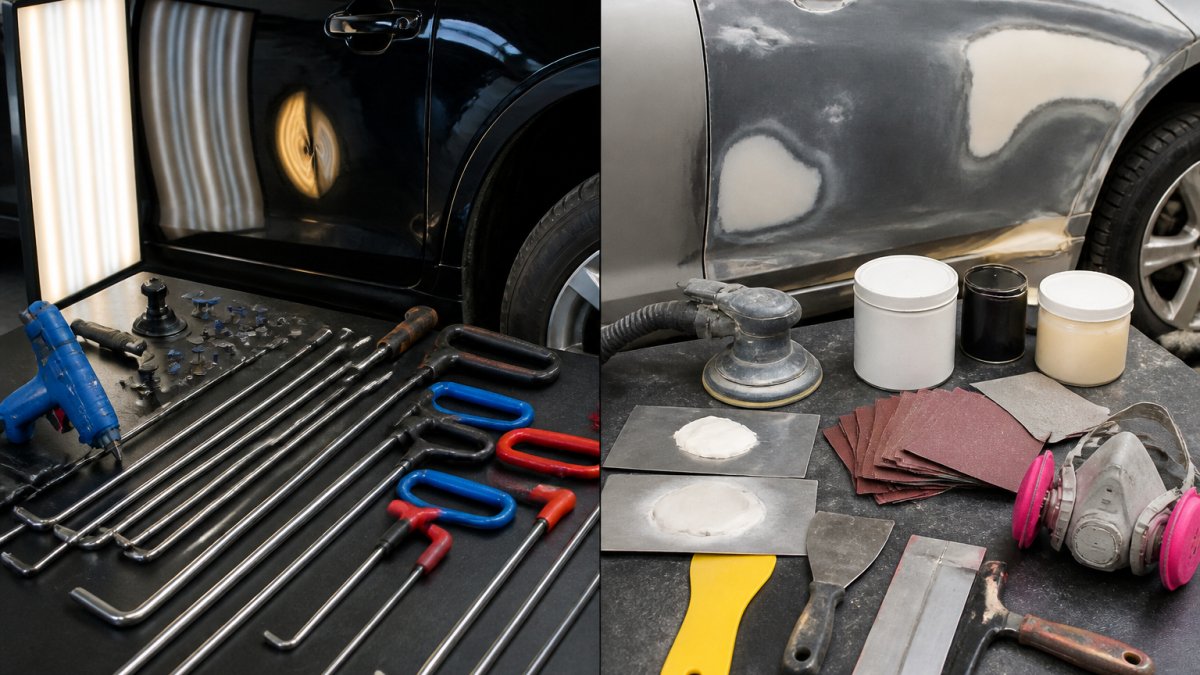
Paintless dent repair (PDR) is a method of removing dents from vehicle panels by carefully reshaping the metal back to its original form without removing paint, applying filler, or refinishing. Traditional bodywork involves filling dents with body filler, sanding the area, repainting, and clear-coating to match the original finish.
The core difference comes down to approach. PDR restores the metal itself. Traditional repair covers the damage with filler and new paint. One preserves your factory finish entirely. The other replaces it.
At Hail Dawgz, we’ve spent over 20 years helping vehicle owners understand paintless dent repair vs traditional bodywork and which method makes sense for their specific damage.
How Paintless Dent Repair Works
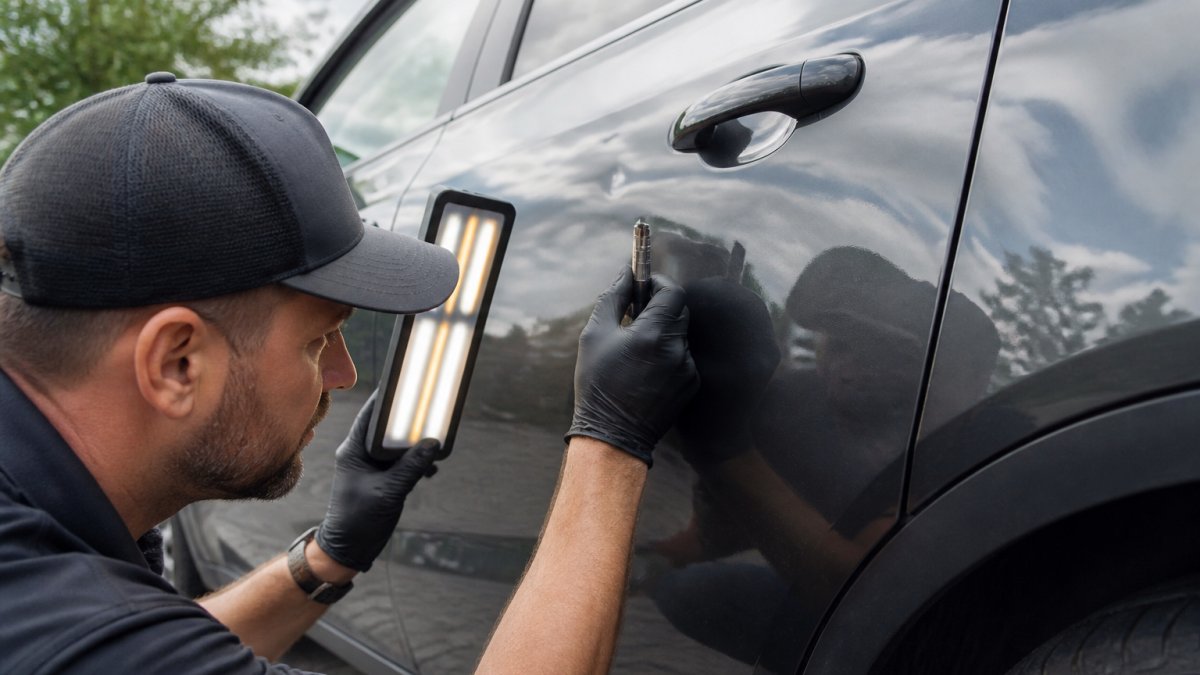
PDR uses specialized tools to access the back side of a damaged panel and gently massage the metal back into shape. A technician works from behind the panel, using use and precision to restore the original contour without breaking the paint surface.
The process involves no sanding, no filler, and no repainting. The factory finish stays intact. This is why PDR is particularly valuable for newer vehicles where maintaining the original paint protects resale value and warranty coverage.
The technique works best on small to medium dents with no sharp creases and no paint damage. Door dings, minor hail damage, and shallow dents in accessible panels are ideal candidates.
How Traditional Auto Body Repair Works
Traditional bodywork starts with assessing the damage and determining whether the panel can be straightened or must be replaced. If the metal is too severely damaged, the panel comes off and gets replaced entirely.
For repairable damage, technicians apply body filler to fill the dent, then sand it smooth to match the surrounding surface. Next comes priming, base coat application, and clear coat. The final step is color matching and buffing to blend the repair with the rest of the vehicle.
This method handles severe damage that PDR cannot address: deep creases, sharp dents, paint damage, and structural issues. It’s also the only option when metal is bent beyond reshaping or when a panel needs replacement.
Paintless Dent Repair Cost vs Traditional Repair Expenses
PDR typically costs significantly less than traditional bodywork for minor to moderate damage (PDR vs Body Shop: Cost, Time & Finish Compared (2026)).
According to Call My Dent Guy’s PDR vs Body Shop comparison, paintless dent repair typically costs 40-60% less than traditional body-shop repairs for suitable damage.
However, cost depends heavily on damage severity, location, and accessibility. A single door ding costs far less than hail damage across multiple panels.
Traditional repair costs reflect the full refinishing process. Material costs, labor time, and paint matching all add up.
The real financial advantage of PDR extends beyond the immediate repair cost. Your factory finish remains untouched, which protects resale value and preserves warranty coverage.
How Long Does Paintless Dent Repair Take?
PDR is significantly faster than traditional repair. A single minor dent may take 30 minutes to 2 hours. Moderate damage across several panels might take a full day.
Traditional bodywork takes considerably longer. The drying time alone for filler, primer, and paint layers can stretch a repair across multiple days. A moderate repair often takes 5-10 days. Severe damage requiring panel replacement can take 2-3 weeks.
Speed matters when you need your vehicle back. PDR’s quick turnaround means less time without your car. Many shops provide free rental vehicles while repairs are underway, but returning to your own car faster is always preferable.
The timeline also affects insurance claims. Faster repairs mean lower rental car costs.
When Is Paintless Dent Repair Not Possible?
PDR has clear limitations. The technique only works when specific conditions are met.
PDR cannot repair dents where paint is cracked, chipped, or scratched.
Deep creases in the metal also exceed PDR’s capability. A sharp, angular crease cannot be smoothed back to factory contour without breaking the paint.
Dents in locations with limited panel access are problematic. If a technician cannot reach behind the panel to apply use, PDR is impossible.
Large dents covering significant panel area often require traditional repair. While PDR can handle surprisingly large damage areas, the practical limits depend on the dent’s shape and the panel’s accessibility.
Damage on vehicles with advanced materials presents another challenge. Modern aluminum panels, composite materials, and vehicles with integrated sensors require specialized knowledge.
Paintless Dent Repair for Hail Damage: Effectiveness and Limitations
Hail damage is one of the most common reasons vehicle owners seek PDR.
PDR excels at hail damage because most hail dents meet the ideal criteria: small size, intact paint, and accessible panel locations.
However, not all hail dents are equal. Large hail can create deeper dents with sharp edges that PDR cannot fully correct.
You can explore Hail damage repair services to understand how our technicians assess which dents respond to PDR and which require alternative approaches.
The real advantage of PDR for hail damage is speed and cost. Repairing 50 small dents with traditional bodywork would take weeks and cost thousands.
Paint condition determines everything. If hail cracked or chipped the paint, those areas require traditional repair regardless of dent size.
Dent Assessment Checklist: Which Method Is Right for Your Damage?
Determining which repair method suits your damage requires evaluating several factors. Use this checklist to assess your situation before calling a repair shop.
Dent Size and Shape
- Small dents (under 2 inches): PDR is suitable
- Medium dents (2-4 inches): PDR may work if paint is intact
- Large dents (over 4 inches): Traditional repair likely needed
- Sharp creases or angular dents: Traditional repair required
- Smooth, rounded dents: PDR candidate
Paint Condition
- Paint intact with no cracks or chips: PDR possible
- Paint cracked, chipped, or scraped: Traditional repair required
- Paint discoloration or fading: PDR preserves original, traditional repair matches new paint
- Multiple paint layers visible: PDR not suitable
Panel Location and Access
- Hood, roof, doors: Usually accessible for PDR
- Fenders and quarter panels: Often accessible, depends on trim
- Areas near trim, sensors, or complex curves: May limit PDR options
- Interior-mounted panels: PDR not possible
Damage Severity
- Single dent: Assess individually
- Multiple dents in one area: PDR if paint intact
- Widespread damage: May require combination approach
- Structural damage: Traditional repair or panel replacement
| Assessment Factor | PDR Suitable | Traditional Repair Needed |
|---|---|---|
| Dent Size | Under 4 inches | Over 4 inches |
| Paint Condition | Intact, no damage | Cracked, chipped, or scraped |
| Dent Shape | Smooth, rounded | Sharp creases, angular |
| Panel Access | Accessible from behind | Limited or no access |
| Damage Extent | Single to moderate dents | Severe, widespread, or structural |
Questions to Ask a Repair Provider
Before committing to a repair method, ask these questions to ensure you’re getting accurate guidance.
About the Damage Assessment
- “Can you confirm the paint is intact, or do you see damage I should know about?”
- “What’s your assessment of dent depth and size?”
- “Are there any areas where you cannot access the panel for PDR?”
About the Repair Method
- “Which method do you recommend for my specific damage, and why?”
- “If you start with PDR and find it won’t work, what’s the plan?”
- “Will my factory finish be preserved, or will the panel need repainting?”
About Cost and Timeline
- “What’s the estimated cost and timeline for your recommended method?”
- “Are there factors that could change the estimate once you start work?”
- “Does your estimate include all labor, materials, and any rental vehicle costs?”
About Insurance
- “Do you work directly with my insurance company?”
- “Will you handle the claim paperwork, or is that my responsibility?”
- “If my insurer wants a different repair method than you recommend, how do we handle that?”
Insurance Claims and Your Repair Method Choice
Insurance coverage depends on your policy type and the specific damage. Most comprehensive policies cover hail damage with a deductible.
Here’s where the repair method matters for your claim: insurers sometimes prefer the most cost-effective repair approach.
At Hail Dawgz, we work directly with all major insurance companies.
Before choosing a repair shop, confirm they work with your insurance company. Some shops specialize in direct-to-insurer repairs, which simplifies the process.
Your deductible applies regardless of repair method. If your deductible is $1,000 and PDR costs $800, you pay the full $800 out of pocket.
Ask your repair shop about zero-deductible programs. Hail Dawgz works with insurers to waive deductibles for customers with comprehensive coverage, making the repair process truly stress-free.
Schedule Your Free Hail Damage Inspection
The best way to determine whether your damage suits PDR or requires traditional bodywork is a professional assessment. A certified technician can evaluate your specific vehicle, examine paint condition, and measure dent depth to recommend the right approach.
Book a free hail damage inspection with Hail Dawgz. Our team will assess your damage, explain which repair method makes sense, and provide a detailed estimate.
With over 20 years of experience in paintless dent repair and traditional bodywork, we understand the nuances of both methods. We’ll be honest about what your vehicle needs and why.
Most hail damage can be repaired faster and more affordably than vehicle owners expect. Find out how much you can save by checking our FAQ for answers to common questions, or see real before-and-after examples of our paintless dent repair work.
Your vehicle deserves to be restored to its pre-damage condition. Let’s make that happen without the stress.
Frequently Asked Questions
Is paintless dent repair cheaper than traditional bodywork?
Yes. PDR avoids the expense of filler, primer, paint, and clear coat. However, cost depends on dent size, location, and whether the paint is intact. For damage requiring paint correction or severe dents, traditional repair may be necessary, which costs more. Request quotes from both methods to compare.
How long does paintless dent repair take compared to traditional repair?
Paintless dent repair is faster. Most minor dents can be repaired in hours or a single day. Traditional bodywork involves multiple steps, disassembly, filling, sanding, repainting, and refinishing, which typically takes several days to a week. Quick turnaround is one of PDR’s key advantages, especially for minor door dings and hail damage with intact paint.
When is paintless dent repair not possible, and what happens then?
Paintless dent repair is not suitable when the paint is damaged, cracked, or scratched; when dents are deep or sharply creased; or when the dent location makes panel access impossible. If a technician assesses your damage and finds PDR cannot fully correct it, traditional bodywork becomes necessary. Always get a free inspection to determine which method applies to your specific damage before committing to a repair plan.
Can paintless dent repair fix hail damage?
Yes, paintless dent repair is highly effective for hail damage when dents are shallow, paint is intact, and the damage is distributed across accessible panels. Hail typically creates numerous small dents ideal for PDR. However, if hail damage includes deep creases, paint damage, or dents in hard-to-reach areas, traditional repair may be needed for those sections. A professional assessment determines which dents qualify for PDR.
Will my insurance cover paintless dent repair, or do I have to pay out of pocket?
Most comprehensive insurance policies cover paintless dent repair, especially for hail damage. Hail Dawgz works directly with major insurance companies to file claims and handle the process, often resulting in zero out-of-pocket cost after your deductible is met. Insurance companies often prefer PDR because it is cost-effective and preserves factory finish. Contact your insurer or ask Hail Dawgz about your specific policy during a free inspection.

