Table of Contents
- Understanding Fleet Vehicle Hail Damage
- Paintless Dent Removal for Commercial Fleets
- Fleet Insurance Hail Damage Claims Process
- Hail Damage Repair Turnaround Time for Fleet Vehicles
- Inspection and Damage Assessment
- Managing Large-Scale Fleet Hail Damage
- Lifetime Warranty and Long-Term Vehicle Protection
- Frequently Asked Questions
Last Updated: October 4, 2026
Understanding Fleet Vehicle Hail Damage
When a hailstorm hits, fleet managers face a compounded problem: multiple vehicles damaged simultaneously, complex insurance coordination, and pressure to keep operations running. Understanding fleet vehicle hail damage repair is critical to your bottom line.
Fleet vehicle hail damage repair involves specialized assessment and restoration techniques designed for commercial vehicles. Hail creates predictable dent patterns across panels, but managing repairs across an entire fleet requires a different approach than single-vehicle service.
A fleet facing hail damage needs a partner who can handle volume, work directly with insurance, and minimize downtime.
Paintless Dent Removal for Commercial Fleets
Paintless dent removal (PDR) is a technique that removes dents without repainting, using specialized tools to massage the metal back to its original shape from behind the panel.
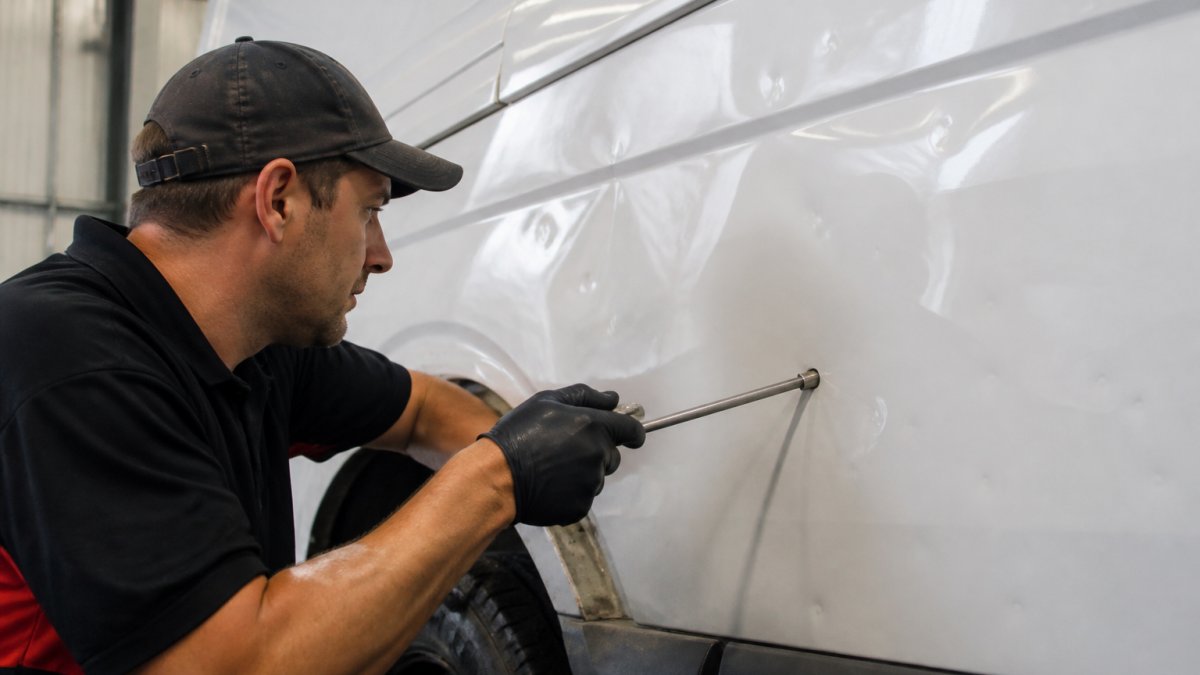
PDR works because metal has memory. When hail strikes, it deforms the panel without breaking the paint.
PDR handles small to medium dents created by most hail. Larger dents or creased metal may require traditional body work, but PDR should always be the first assessment.
How PDR Preserves Factory Finish and Paint Integrity
The factory finish is engineered for durability and appearance. Once broken through sanding, primer, or repainting, you’ve altered the vehicle’s original protection. PDR avoids this by working the metal without touching the paint.
This matters for fleet resale value. A vehicle with original factory paint commands a premium. Insurance companies often prefer PDR when damage qualifies, and comprehensive coverage typically covers PDR at no deductible.
Paint integrity affects long-term durability. Factory coatings are applied in controlled conditions with specific curing times and UV protection. Aftermarket paint introduces variables; PDR eliminates that risk.
When Traditional Body Shop Repair Is Necessary
Larger dents, creased panels, or paint damage require traditional body shop repair, which involves sanding, primer, paint, and panel work. It’s more time-intensive but sometimes necessary.
The decision point comes during the damage assessment. A certified technician will examine each dent and determine whether PDR is viable or if traditional repair is needed. Some vehicles will have a mix, PDR for 80% of the damage, traditional work for the remaining 20%.
Fleet Insurance Hail Damage Claims Process
The insurance claim process often creates friction for fleet managers. Fleet claims involve multiple vehicles, PO processing, net 30 billing terms, and coordination between insurance and the repair shop.
At Hail Dawgz, we work directly with all major insurance companies, handling estimates, documentation, and claim coordination on your behalf.
Working with Your Claims Adjuster
Your claims adjuster will inspect the damage, determine coverage, and assign a repair estimate. For fleet damage, this process takes longer due to higher volume.
Documentation is key. Photographs of each vehicle, damage location, and severity reduce back-and-forth. We provide this automatically as part of our assessment process.
Adjusters sometimes underestimate repair costs. If you disagree, request a re-evaluation or independent appraiser. Our 20+ years of experience gives adjusters confidence in our numbers.
Zero Out-of-Pocket Repair with Comprehensive Coverage
If your fleet has comprehensive coverage, you typically won’t pay out of pocket for hail damage repair. Comprehensive coverage is designed for weather events including hail.
Your deductible applies per vehicle. Many fleet policies negotiate lower deductibles or waive them for weather events.
The “zero out-of-pocket” promise only holds if the repair estimate meets or exceeds your deductible. For most hail events, damage exceeds deductibles, but verify your specific policy.
Hail Damage Repair Turnaround Time for Fleet Vehicles
Hail damage repair turnaround time varies based on damage severity, repair method, and scheduling. PDR takes days; traditional body work takes longer. Fleet timelines depend on vehicle volume and shop capacity.
The right partner balances speed with quality and scales capacity to your volume.
Repair Method Timelines and Capacity Planning
Paintless Dent Removal (PDR) turnaround:
Technician capacity is essential when selecting a repair partner.
Traditional body work turnaround:
Ask whether the shop runs vehicles in parallel or sequentially.
Mixed repair scenarios: Most large hail events involve both PDR and body work. A shop’s ability to run these in parallel separates efficient operations from bottlenecks.
Multi-Vehicle Scheduling and Downtime Management
Managing downtime is often more expensive than the repair itself. Minimizing downtime is a core part of fleet repair strategy.
We schedule vehicles in phases. We assess all vehicles simultaneously and coordinate repairs based on damage severity and repair method.
Intake and assessment phase (24-48 hours): All vehicles are photographed, assessed, and categorized by repair method.
Body work phase (10-20 business days): Vehicles requiring paint or structural repair are scheduled in the paint booth.
Quality control and delivery (1-2 business days): All vehicles undergo final inspection, touch-up if needed, and detailing before return.
We provide free rental vehicles during repairs.
Communication and Progress Tracking
For large fleet repairs, daily communication is essential. You need to know which vehicles are in progress, complete, and the timeline for the remainder.
A professional fleet repair partner should provide daily progress reports, vehicle-level status, photo documentation, insurance updates, and an escalation protocol.
A repair shop that won’t provide regular updates is not equipped for fleet work.
Inspection and Damage Assessment
A thorough inspection determines what needs to be fixed and which repair method is appropriate. This is where hidden damage often surfaces.
Hail can damage components beyond the visible dent: cracked paint, compromised seals, or structural issues. A visual inspection alone misses these. We use a systematic assessment process that checks for both obvious and hidden damage.
Hidden Impact Detection and Vehicle Inspection Standards
Hidden impact refers to damage that isn’t immediately visible, a cracked seal, a bent frame rail, or paint damage on an interior panel. Hail can cause this damage without leaving an obvious dent.
Our inspection process includes a detailed walk-around of each vehicle, checking for paint cracks, checking seals and weatherstripping, and looking for any structural issues. We document everything photographically so there’s a clear record of what was damaged and what was repaired.
This thoroughness protects you and your insurance company. If hidden damage surfaces later, it’s already documented and covered under the original claim. You won’t face surprises after the vehicle is back in service.
Managing Large-Scale Fleet Hail Damage
When a major hailstorm hits, fleet managers face a unique challenge: coordinating repairs across dozens or hundreds of vehicles while keeping operations running and managing insurance claims. This requires a partner who understands fleet logistics, not just repair techniques.
Handling Multiple Vehicles Simultaneously
Large-scale fleet damage demands a shop with the capacity to handle volume. A major fleet event may involve 10, 20, or more vehicles. You need a partner who can scale.
At Hail Dawgz, we’ve built our operation specifically for this. We can receive, assess, and begin repairs on a fleet of vehicles in a single day. Our team coordinates scheduling so that PDR work moves through quickly while body work is handled in parallel, preventing bottlenecks.
Communication is critical at scale. You need daily updates on progress, clear documentation of what’s been completed, and transparency about timeline and costs. We provide this as standard practice for fleet accounts.
PO Processing and Net 30 Billing Terms
Fleet accounts typically operate on purchase order (PO) systems with net 30 billing terms. This means you don’t pay when the work is completed; you pay 30 days after invoice.
Our billing process is designed for this. We issue invoices with clear itemization, vehicle identification, damage description, repair method, and cost per vehicle. Your accounting department can match invoices to POs and process payment on your standard cycle.
Documentation is meticulous. Every vehicle has a file with photos before and after repair, the estimate, the invoice, and any insurance correspondence. This makes your record-keeping clean and auditable.
Lifetime Warranty and Long-Term Vehicle Protection
Warranty coverage is a critical part of fleet repair. You need confidence that the work will hold up over time, not fail after a few months of use. A lifetime warranty on paintless dent removal means the repair is guaranteed for the life of the vehicle.
This warranty covers the PDR work itself, if a dent reappears, we’ll fix it at no cost. It doesn’t cover new damage from accidents or additional hail, but it does guarantee that the original repair is permanent.
For body work, warranty terms vary. Clarify warranty terms before repair begins so there’s no confusion later.
Fleet vehicle hail damage can be a logistical nightmare, but with the right partner, it becomes manageable. If your fleet has experienced hail damage, a free inspection will show you exactly what you’re working with and what the timeline looks like. Contact Hail Dawgz for a free fleet hail damage assessment and get your vehicles back in service faster.
Frequently Asked Questions
How does paintless dent repair work for fleet vehicles with widespread hail damage?
Paintless dent repair (PDR) uses specialized tools to access dents from behind the panel and massage the metal back to its original shape, preserving your vehicle’s factory finish and paint integrity. Licensed technicians apply controlled pressure following the metal’s memory to restore the panel’s contour. PDR works best on shallow to moderate dents without paint damage. For fleet vehicles with extensive hail damage, technicians assess which dents qualify for PDR and which panels may need traditional body shop repair to ensure complete restoration.
What’s the typical hail damage repair turnaround time for a fleet with multiple vehicles?
Turnaround time depends on damage severity and fleet size. Single-vehicle PDR jobs often take 1-3 days, while multi-vehicle scheduling allows technicians to work on several cars simultaneously, reducing overall downtime. A fleet of 12 vehicles may take 2-3 weeks when coordinated efficiently. Certified technicians prioritize vehicle availability so your fleet stays operational. Exact timing is determined during the initial vehicle inspection and repair estimate.
Will I really pay zero out of pocket for fleet hail damage repairs with comprehensive coverage?
Yes, with comprehensive insurance coverage, your policy covers hail damage minus your deductible. We work directly with all major insurance companies and submit repair documentation to ensure claims are processed smoothly. Your deductible is the only out-of-pocket cost, we handle everything else. We verify your coverage upfront and coordinate directly with your claims adjuster, so there are no hidden fees or surprise bills. Our goal is a completely stress-free repair experience.
How do fleet insurance hail damage claims work when you have multiple vehicles damaged?
When multiple fleet vehicles sustain hail damage, each vehicle is typically filed as a separate claim under your comprehensive coverage. We provide detailed repair estimates and damage documentation for each vehicle, which we submit directly to your insurance company. Our program managers coordinate with your claims adjuster to ensure all vehicles are processed efficiently. We handle PO processing and work within your company’s net 30 billing terms, so the claims process doesn’t disrupt your cash flow or operations.
What happens if paintless dent repair can’t fix all the damage, will my repair cost increase?
During the initial vehicle inspection, our licensed technicians assess every dent and impact to determine which damage qualifies for PDR and which may require traditional body shop repair. We provide a transparent repair estimate upfront so you know exactly what’s included. If additional work is needed beyond PDR, we discuss options with you and your claims adjuster before proceeding. There are no surprises, you’ll understand the scope and cost before any work begins.
Does hail damage affect my fleet vehicle’s resale value even after repair?
Professional hail damage repair using PDR preserves your vehicle’s factory finish and paint integrity, minimizing long-term resale impact. When repair is done correctly by certified technicians, the restored panels return to their pre-damage condition. Thorough documentation of the repair and a lifetime warranty on PDR work provide buyers with confidence in the vehicle’s history. Prompt, quality repair is far better for resale value than leaving damage unaddressed.
Can you actually handle a large fleet hail damage claim, or will I need to split it between multiple shops?
Yes, we handle large-scale fleet hail damage by coordinating multi-vehicle scheduling and managing simultaneous repairs. Our team of certified technicians can work on multiple vehicles at once, dramatically reducing downtime for your fleet. We streamline PO processing and billing to fit your company’s net 30 terms. Free rental vehicles are provided so your operations stay running while repairs are underway. Our 20+ years of experience managing fleet repairs means we have the capacity and systems to handle your entire claim in one place.
