Table of Contents
- What Is Paintless Dent Repair and How Does It Work?
- How PDR Works for Hail Damage
- PDR vs Conventional Body Shop Repair
- How Long Does Hail Repair Take?
- The Hail Damage Insurance Claim Process
- When Paintless Dent Repair Is Not an Option
- Conclusion
- Frequently Asked Questions
Last Updated: October 2, 2026
What Is Paintless Dent Repair and How Does It Work?
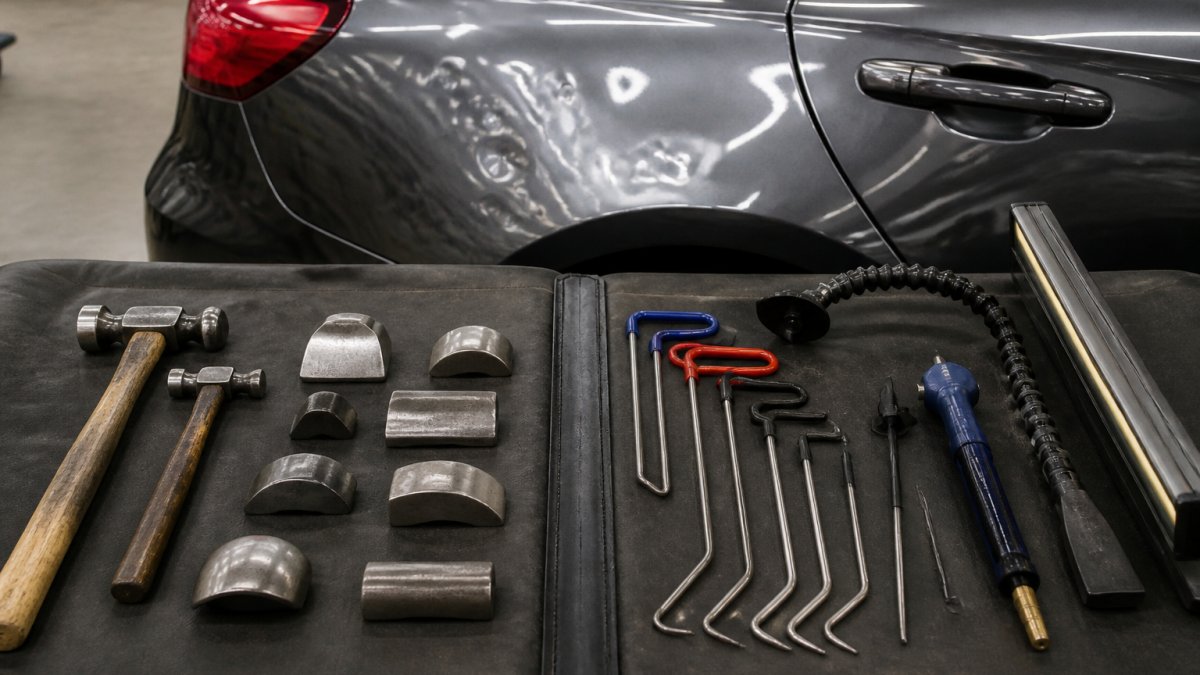
Paintless dent repair is a method of removing dents from a vehicle’s body panels without sanding, filling, or repainting the surface. Technicians use metal rods and specialized tools to push dents out from behind the panel, working the metal back to its original shape.
The process relies on two things: metal memory and paint elasticity. When hail strikes a panel, the metal flexes and holds a dent. But the metal “remembers” its original form, and skilled hands can guide it back.
Hail Dawgz has spent over 20 years refining this craft. Our certified technicians work directly with your insurance company, so you never pay out of pocket for covered damage.
Here’s the basic process:
- Inspect the damage under proper lighting
- Access the back of the panel through existing openings
- Apply gradual pressure to massage the dent out
- Verify the repair with reflection checks
No fillers. No sanding. Your factory paint stays intact.
The Role of Specialized Lighting and Reflection Boards
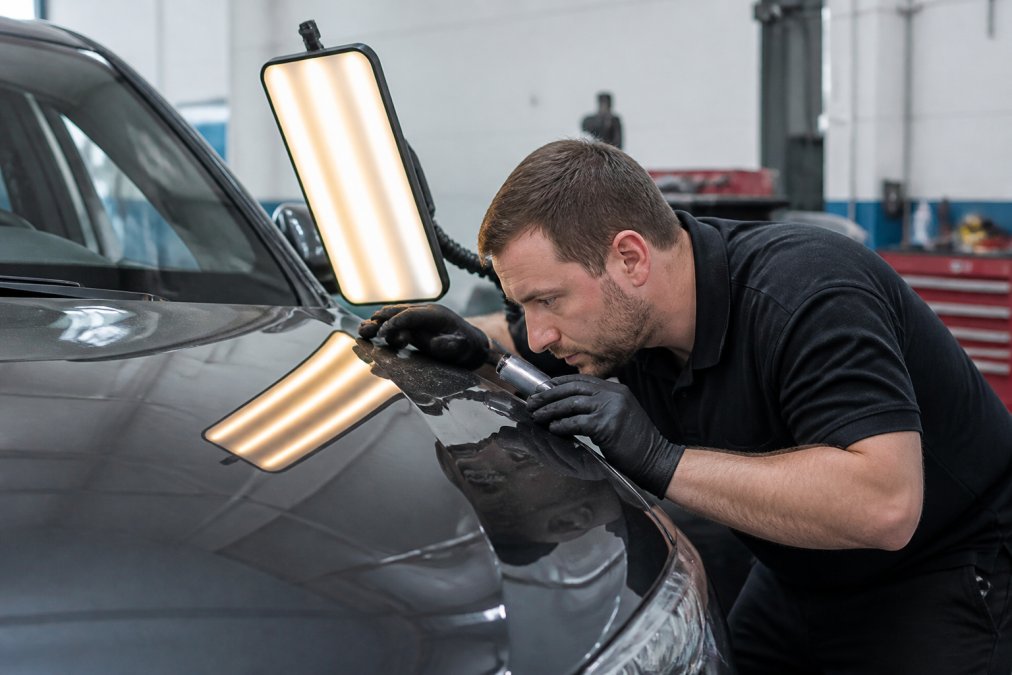
Lighting makes or breaks paintless dent repair. A dent you can barely see in daylight becomes obvious under the right reflection.
Technicians use reflection boards and LED light strips to create a controlled reflection across the panel. Any distortion in that reflection reveals a dent’s exact location, depth, and edges.
This matters because hail dents are often shallow and clustered. Without proper lighting, a technician might miss small dents or push too hard and stretch the metal. Reflection boards let us work with precision, checking progress after every few pushes.
How PDR Works for Hail Damage
Hail damage is the ideal candidate for paintless dent repair. Hail creates rounded, shallow dents that rarely crack paint, which means the metal can be worked back without refinishing.
When a hail storm hits, dozens or even hundreds of small dents can cover a single panel. Traditional repair would mean sanding, filling, and repainting each one. That’s slow, expensive, and it destroys your factory finish.
PDR treats hail damage differently:
- Each dent gets mapped under reflection lighting
- Technicians work from the underside of the panel
- Metal memory pulls the surface back to flat
- The original clear coat stays untouched
The key advantage is paint integrity. Factory paint is applied in a controlled environment and baked on. PDR keeps it.
PDR vs Conventional Body Shop Repair
Conventional body work fixes dents by removing or covering them. PDR reverses them. That single difference cascades into cost, time, paint integrity, and, most importantly, what your vehicle is worth when you sell or trade it.
| Factor | Paintless Dent Repair | Conventional Body Work |
|---|---|---|
| Factory paint | Preserved | Often sanded and repainted |
| Filler and sanding | Not needed | Standard practice |
| Repair time | Usually days | Often weeks |
| Panel replacement | Rarely needed | Sometimes required |
| Paint match risk | None, original finish stays | Possible mismatch, especially on metallics and pearls |
| Vehicle history | Typically no accident record | May be reported as a repair |
| Resale impact | Maintained | Can be reduced |
Why the Resale Value Gap Is Bigger Than Most Drivers Realize
When a body shop repaints a panel, that work can end up on a vehicle history report. A repainted panel is also detectable by a trained appraiser or a paint-depth gauge, and buyers discount for it.
PDR avoids both problems. Because the factory paint stays intact and no panels are replaced or refinished, there is usually nothing to report. That means a hail-damaged vehicle repaired with PDR can often be sold or traded as a clean vehicle, while the same vehicle repaired conventionally may carry a repair notation.
The clean-history vehicle typically commands more at trade-in and is easier to sell private-party. That spread is the real cost of choosing conventional repair for damage PDR could have handled.
Steel vs. Aluminum: Why the Panel Material Changes the Math
Steel has strong metal memory, it flexes and largely returns to shape when worked correctly, which is why PDR works so well on steel hoods, roofs, and doors. Aluminum behaves differently. It work-hardens as it is bent, meaning each push makes the metal stiffer and more prone to cracking. Aluminum panels also tend to be thinner and less forgiving of heat.
That does not mean aluminum can’t be repaired with PDR, many late-model trucks, SUVs, and performance vehicles use aluminum hoods and panels, and skilled technicians repair them every day.
When Conventional Repair Is the Right Call
PDR is not universal. Conventional body work is the correct choice when:
- Paint is cracked, chipped, or flaking at the dent
- The metal is sharply creased or visibly stretched
- Damage sits on a panel edge, seam, or body line where access is limited
- A previous repair left filler in the area
- The panel is plastic or trim rather than metal
Filler shrinks over time and can crack, creating problems years later, and it is a dead giveaway to any appraiser.
PDR preserves your factory finish and keeps a repair off your vehicle’s history, which protects resale value in a way conventional body work cannot.
How Long Does Hail Repair Take?
Most hail damage repairs take a few days, not weeks. The exact timeline depends on dent count, panel access, and how many panels are affected.
Here’s what drives the timeline:
- Total dent count
- Whether dents sit on single or double panels
- Access behind each panel
- Parts that need removal and reinstallation
The Hail Damage Insurance Claim Process
Filing a hail claim is simpler than most people expect, and you do not have to face it alone. Hail damage is typically covered under the comprehensive portion of an auto policy, not collision, which matters, because comprehensive claims generally do not affect your rate the way an at-fault collision claim can. Confirm the specifics with your insurer, since policy language varies.
Here is how the process usually works:
- File a claim with your insurance company as soon as practical after the storm. Most carriers let you file online, by phone, or through an app.
- Get an inspection. Either an adjuster comes to you, or you take the vehicle to a shop for an estimate. Many carriers now use photo-based or app-based estimating for hail.
- Review the approved scope. The adjuster produces an estimate listing dent count, panels affected, and the approved repair method.
- Choose your shop. You generally have the right to choose your own repair facility. The shop then works from the approved scope.
- Schedule and complete the repair, then pick up your vehicle.
How PDR Changes the Claim
This is where PDR pays off beyond the repair itself. A conventional repair estimate includes refinishing labor, paint materials, and often panel replacement, line items that inflate the claim. A PDR estimate is largely labor: mapping dents, accessing panels, and working the metal. Fewer materials, no paint booth time, no replacement panels.
What to Watch For
- Incomplete inspections. Adjusters can miss dents hidden by dirt, road film, or poor lighting. Wash the vehicle before inspection if you can, and inspect in direct sun or under shop lighting.
- Settlement before full inspection. Never accept a settlement before a thorough inspection. Once you sign, reopening the claim is a fight.
- Deductible confusion. If the damage is covered, you typically pay only your deductible. Ask upfront whether the estimate is written net of deductible or gross.
- Supplemental claims. If the shop finds additional damage after work begins, a supplement can usually be filed with the adjuster. Ask your shop how they handle supplements.
Hail Dawgz works directly with all major insurance companies. We document the damage thoroughly, panel by panel, dent by dent, and communicate with your adjuster so nothing gets missed or lowballed.
Do not authorize repairs before the claim scope is approved, and do not sign a settlement you have not reviewed against a full inspection. A missed dent or an under-scoped panel is far easier to fix before you sign than after.
PDR tends to produce a smaller, simpler claim than conventional repair, fewer materials, no paint work, no panel replacement. That usually means faster approval and less friction with your adjuster, provided the damage is documented thoroughly from the start.
When Paintless Dent Repair Is Not an Option
PDR can’t fix everything. It works on the metal, not the paint, so damage that breaks the paint surface needs a different approach.
Signs PDR won’t work:
- Cracked or chipped paint at the dent
- Sharp creases with stretched metal
- Dents on panel edges or seams
- Previous body work with filler in the area
- Dents on plastic bumpers or trim
Conclusion
Hail damage is stressful, and the repair options can feel overwhelming. But the choice is clearer than most drivers realize.
Frequently Asked Questions
Does paintless dent repair really work for severe hail damage?
PDR works for most hail damage, including many severe cases, as long as the metal is not stretched beyond repair and the paint remains intact. Technicians use specialized tools to massage dents from behind the panel. If the hail storm caused cracked paint or sharp creases, traditional repair may be needed. A free inspection can confirm whether PDR is viable for your vehicle.
How long does hail repair take using PDR?
Most hail damage repairs using PDR take one to three days, depending on the number of dents and their severity. A vehicle with light damage might be ready the same day, while extensive hail storm damage could take a week. PDR is significantly faster than conventional body work, which often requires sanding, priming, and painting that adds days to the turnaround time.
Does paintless dent repair affect my vehicle’s factory warranty?
No. PDR preserves your factory paint and original finish, so it does not void your warranty. Because the process is non-invasive and does not involve filler, sanding, or repainting, your vehicle’s corrosion warranty and paint warranty remain intact. This is one of the main reasons PDR is preferred for newer vehicles still under manufacturer coverage.
Will hail dents return after paintless dent repair?
No, properly repaired dents do not return. PDR relies on the metal’s memory to return to its original shape. Once a technician has massaged the dent out, the panel stays flat unless it is hit again. The repair is permanent, and the factory paint remains undamaged, which helps preserve your vehicle’s resale value and original finish.
