Table of Contents
- What Certification Actually Means for Paintless Dent Repair
- Questions to Ask a Dent Repair Specialist Before You Hire
- How to Spot Quality PDR Work (and Fake Certifications)
- Is Paintless Dent Repair Covered by Insurance?
- Mobile vs. Shop-Based PDR: Which Service Model Fits Your Needs
- How to Find Qualified PDR Technicians in Your Area
- Frequently Asked Questions
Last Updated: September 30, 2026
What Certification Actually Means for Paintless Dent Repair
Finding a certified paintless dent repair technician starts with understanding what that certification actually proves. Paintless dent repair is a method that removes dents by working the metal from behind the panel, keeping your factory paint intact. A certified technician has completed formal training and testing in those techniques.
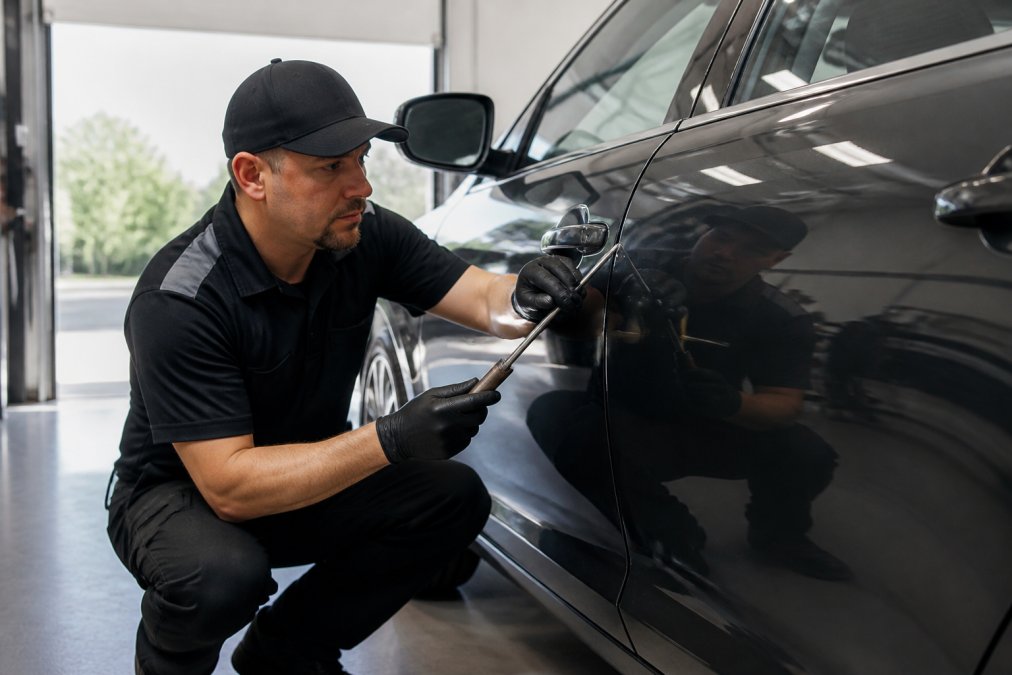
That matters more than most drivers realize. PDR work depends on feel, light, and precise pressure. One wrong push can stretch the metal or crack the paint, and then you’re looking at a traditional body shop bill instead of a simple dent removal.
This guide from Hail Dawgz walks through exactly how to find certified paintless dent repair technicians, what to ask them, and how to spot the ones who only claim to be qualified. Below, we’ll show you the questions that separate real pros from pretenders.
The Difference Between PDR and Traditional Body Work
Traditional auto body repair fills, sands, and repaints the damaged area. Paintless dent repair does none of that. It preserves your factory finish, which protects your car’s resale value.
The trade-off is that PDR only works on certain damage. It handles hail damage, door dings, and creases where the paint is still intact. If the paint is cracked or the metal is stretched too far, traditional work is the only option.
Questions to Ask a Dent Repair Specialist Before You Hire
Before you hand over your keys, ask direct questions. A qualified technician will answer them without hesitation. A shaky one will dodge.
Here’s what to ask any dent repair specialist:
- How many years have you worked in paintless dent repair?
- Which certification body trained and tested you?
- Can you show proof of current insurance?
- Do you use glue pulling, rod access, or both?
- What happens if the paint cracks during repair?
- Will you put the repair terms in writing?
How to Verify Technician Credentials and Insurance
Verification is simple, and most drivers skip it. Ask for the certificate, then contact the issuing organization to confirm it’s real. A legitimate credential can be checked directly with the training body.
How to Spot Quality PDR Work (and Fake Certifications)
The fastest way to spot quality PDR work is to look at the shop’s finished vehicles in direct sunlight. Good work disappears. Bad work shows as wavy reflections, cloudy paint, or faint dents that never fully came out.
- The certificate names no training organization
- The issuing body has no website or phone number
- The technician can’t explain what the training covered
- The credential has no issue date or technician ID number
- The shop won’t let you contact the certifying body
A certificate that can’t be verified with the issuing organization is worth nothing. Hiring an uncertified technician can void your insurance claim and leave you paying for a repaint out of pocket.
Is Paintless Dent Repair Covered by Insurance?
In most cases, yes. Paintless dent repair is covered by comprehensive auto insurance, the same coverage that handles hail damage and storm claims. Your insurer pays for the repair minus your deductible.
Mobile vs. Shop-Based PDR: Which Service Model Fits Your Needs
Mobile PDR brings the technician to your driveway or office. Shop-based PDR means you drop the car off at a fixed location. Each has real trade-offs.
| Factor | Mobile PDR | Shop-Based PDR |
|---|---|---|
| Convenience | High, comes to you | Requires drop-off |
| Best for | Door dings, small dents | Hail damage, fleets |
| Equipment | Limited | Full tool set |
| Turnaround | Often same day | Varies by volume |
| Rental car | Rarely offered | Commonly provided |
For a single door ding, mobile PDR is usually the smarter call. For hail damage across multiple panels, a shop-based repair gives the technician the lighting and access needed to do it right the first time.
How to Find Qualified PDR Technicians in Your Area
Most guides on this topic are written by directories, which means their advice stops at “search online and read reviews.” That is the weakest possible filter. A better approach is to source candidates from channels where someone other than the technician has already done a vetting pass, then run your own verification on top.
Channel 1: Insurer Direct Repair Networks
If you are filing a comprehensive claim, ask your insurer whether it maintains a direct repair program for paintless dent repair. Shops on those lists have already passed an insurer’s credential, insurance, and customer-satisfaction review. You are not required to use a network shop, you can choose any licensed shop, but a network shop removes the first layer of risk.
Channel 2: Dealership Service Departments
New-car dealerships send dent work out constantly, and they tend to use the same two or three technicians for years. Call the service department of a franchise dealership near you and ask who they use for PDR on trade-ins and lot damage. They have no incentive to recommend a bad technician, because rework costs them money.
Channel 3: Trade and Association Directories
Industry associations that serve collision repair maintain member directories searchable by specialty. These are more reliable than a general search engine result because membership requires dues, continuing education, or both. Cross-check any name you find against the credential verification steps above.
Channel 4: Body Shops That Do Not Do PDR
A traditional collision shop that does not offer paintless dent repair will still refer customers out. Ask them who they trust with a car they cannot fix in-house. This is one of the few referral sources where the recommender has technical knowledge and no financial stake in the answer.
Channel 5: Local Enthusiast and Owner Communities
Car clubs, regional owner forums, and neighborhood groups surface technicians who have done repeat work for the same people over years. The signal to look for is not a single glowing review, it is the same name appearing across multiple threads over multiple years.
The Ten-Minute Filter
Once you have two or three names, run this filter before you call:
- Confirm the credential name and the issuing organization on the shop’s site
- Verify the credential directly with the issuing body (see the verification section above)
- Confirm active general liability insurance via the insurer, not the shop
- Read reviews specifically for mentions of rework, visible dents after repair, or paint damage
- Ask for photos of completed hail damage repairs, not just door dings
- Ask what happens if the paint cracks during the repair
- Get the warranty terms in writing before work starts
- Ask whether the shop bills your insurer directly or expects payment upfront
Warranty: The Filter Most Drivers Skip
A written warranty is the single best predictor of whether a shop expects to see you again. A standard PDR warranty covers the repaired area against the dent reappearing or the repair failing, for a defined period, commonly a lifetime of your ownership for the specific panel repaired, though terms vary widely by shop. What matters is not the length but the specificity: which panels, which damage types, and what remedy (re-repair, refund, or credit).
Ask three questions and get the answers in writing:
- How long does the warranty run, and does it transfer if you sell the car?
- Does it cover the specific damage type being repaired, or only workmanship?
- If the dent returns, is the remedy a free re-repair or a partial refund?
The three checks that matter most: a verifiable certification, proof of active insurance, and a written warranty that names the panel and the remedy. Skip any one of them and you are carrying risk the shop should be carrying.
Match the specialist to the damage. Door dings and small creases are entry-level PDR work. Large-panel hail damage, body-line creases, and aluminum panels require a technician with specific experience in those damage types, ask for examples before you book.
Frequently Asked Questions
What certifications should a professional PDR technician hold?
Look for technicians certified by industry associations like the National Alliance of Paintless Dent Repair Technicians (NAPDRT) or the Paintless Dent Repair Technicians Association (PDRTA). These programs require hands-on training, written exams, and ongoing education. A master technician certification indicates advanced skill with complex dents, including hail damage and door dings on body lines. Ask to see the certificate and verify the issuing organization is legitimate, not a pay-to-print website.
How can I verify if a PDR technician is insured?
Request a certificate of insurance directly from the technician or shop. It should show general liability coverage and, if they drive your vehicle, garage keepers coverage. Call the insurance company listed on the certificate to confirm the policy is active and covers paintless dent repair work. Reputable technicians carry at least $1 million in liability coverage. If they hesitate or cannot provide proof, walk away. Your auto insurance may not cover damage caused by an uninsured technician.
Is paintless dent repair covered by insurance for hail damage?
Yes, most comprehensive auto insurance policies cover paintless dent repair for hail damage. Your insurer will typically pay for repairs minus your deductible. Hail Dawgz works directly with all major insurance companies to handle the claim process, ensuring zero out of pocket repair costs for covered claims. Check your policy or ask your adjuster before scheduling repairs.
How do I know if a PDR technician is actually qualified to fix my hail damage?
Ask for their certification number and verify it with the issuing association. Request before-and-after photos of similar hail damage repairs they have completed. A qualified technician will explain their repair methodology, including how they access dents behind panels and use metal memory to reshape the metal without damaging paint integrity. They should also offer a written warranty on the repair. If they cannot show proof of past work or explain the process clearly, find another provider.
Hail damage rarely waits for a convenient moment, and neither should your repair. Hail Dawgz offers free hail damage inspections, works directly with all major insurance companies, and provides a free rental vehicle so you’re never stranded. Our certified technicians use paintless dent repair to preserve your factory finish and protect your vehicle’s value. Get started with Hail Dawgz and get your car back to its pre-damage condition without the stress.
